
Clean Power Plan Myth:
Myth: The CPP is an effective way to substantially lower CO2 and other emissions at virtually no cost.
The EPA’s Clean Power Plan (CPP) forces states to reduce their power plants’ CO2 emissions by 32%.
Myth Part 1: The CPP will help significantly lower global CO2 emissions.
The Coal Truth: Domestic emissions reductions will have at most a small impact on global emissions–and a major negative impact on Americans who have to pay higher power costs. [1][2]
Myth Part 2: The CPP will not drive up your power bill.
The Coal Truth: If it saved money to shut down plants prematurely and use unreliable energy from solar and wind, the government wouldn’t have to force communities to do it. [3]
Myth Part 3: The CPP will also protect you from dangerous air pollution.
The Coal Truth: The best way to protect people from air pollution is to improve plants that need it–not to shut down dozens of clean-burning coal plants for a reason that has nothing to do with air quality (CO2).
The Coal Truth
The CPP, by restricting communities’ freedom to choose their power sources, will dramatically increase power prices and increase climate danger.
The cost of energy: Increasing our reliance on unreliable energy will increase the cost of energy.
The CPP makes energy more expensive and unreliable, which is bad for every aspect of life–including health and climate safety.
- If it saved money to shut down plants prematurely and use unreliable energy from solar and wind, the government wouldn’t have to force communities to do it.
- Germany’s residential power prices have more than doubled since 2000, when the energy policy promoting solar and wind started with the goal of phasing out coal power. [4]
- Denmark has seen rising electricity prices as it uses increasingly larger amounts of wind power since the 1980s. [5]
The impact of high energy costs: When energy becomes more expensive and less reliable, every price in our lives eventually goes up–food, clothing, shelter, medical care–which hurts the lowest income most of all.
- All products require energy throughout their life cycle from mining and processing of the raw materials to manufacturing and transport to disassembling and waste management. This concept is called “embodied energy” and reflects the fact that everything we use requires energy-intensive processes to be practically available at our service. [6]
- For example, a ton of cement uses about 4-5 million Btu’s to manufacture. That does not include the mining of raw materials, transportation, and final use. It’s one of the most energy-intensive processes and consumes significant amounts of energy in form coal and electric power. A metric tonne of US cement costs about $113, 1 MMBtu in coal cost about $2, and so a doubling of that price would increase manufacturing cost by 7%.
- Health problems caused by high energy prices include: not being able to afford nutritious food, not being able to afford sufficient heat in the winter, not being able to afford sufficient air-conditioning in the summer, and blackouts.
The impact of high energy costs on climate danger: By increasing the cost of energy, the CPP will make us less safe from climate.
- Wealthier countries are safer from disasters and climate impacts than poorer countries, not because they have better climates but because they have more wealth and better technology. [7]
- Thanks to technology powered by abundant and affordable energy, we enjoy the safest climate in history of humanity. Climate-related deaths have decreased by 98 percent over the last century. [8]
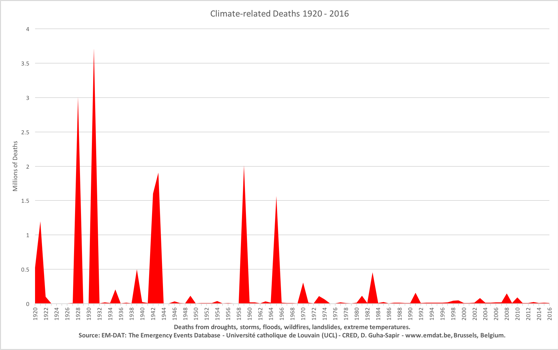
- Climate danger problems caused by high energy prices include: no protection from extreme heat and cold, flimsier buildings, more frequent blackouts, less technology for good forecasting, fewer resources for disaster preparedness and evacuation, etc.
The best policy?
The government should let communities decide on the best power to meet their needs–and those concerned about CO2 should create competitive alternatives, not expensive and unreliable burdens.
Sources & Links
[1] IER Commentary http://instituteforenergyresearch.org/analysis/epas-clean-power-plan-hikes-prices-in-all-47-states-that-it-regulates/
U.S. Chamber’s Global Energy Institute analysis https://www.globalenergyinstitute.org/eia-analysis-shows-epas-carbon-regulations-all-economic-pain-no-climate-gain
According to EIA’s 2015 analysis, “The Clean Power Plan has a significant effect on projected retirements and additions of electric generation capacity,” meaning that CPP would prematurely retire a lot of coal, switch to natural gas earlier than without it, and also add significant capacity of wind and solar to the power grid starting in the 2020s. https://www.eia.gov/analysis/requests/powerplants/cleanplan/pdf/powerplant.pdf
[2] By Paul C. “Chip” Knappenberger and Patrick J. Michaels – 0.02°C Temperature Rise Averted: The Vital Number Missing from the EPA’s “By the Numbers” Fact Sheet https://www.cato.org/blog/002degc-temperature-rise-averted-vital-number-missing-epas-numbers-fact-sheet
[3] An industry-sponsored impact study by NERA Economic Consulting in 2015 concluded hundreds of billions of dollars in additional cost and increasing electricity bills for US consumers. http://www.nera.com/publications/archive/2015/energy-and-consumer-impacts-of-epas-clean-power-plan.html
[4] Federal Association of the German Energy and Water Industries (BDEW) Strompreisanalyse January 2018
Institute for Energy Research – The Levelized Cost of electricity from Existing Generation Sources
Eurostat Energy Main Tables for Denmark
[5] Eurostat
[6] https://www.etoolglobal.com/wp-content/uploads/2012/10/Embodied-Energy-Paper-Richard-Haynes.pdf
http://www.yourhome.gov.au/materials/embodied-energy
[7] http://www.nzherald.co.nz/nz/news/article.cfm?c_id=1&objectid=10672097
[8] http://emdat.be/
